 Save
Save The first time I tasted muhammara was at a cramped Damascus kitchen where the cook insisted the secret wasn't in the pomegranate molasses but in letting the peppers char until they were nearly black. I've made it dozens of times since, and that lesson stuck with me. This dip became my gateway to understanding how a handful of pantry staples could sing together in ways I never expected. There's something almost magical about how roasted peppers transform from sweet to complex, how walnuts add richness without cream, and how pomegranate molasses brings this sharp-edged brightness that catches you off guard. Now it's the dish I make when I want to feel connected to a place I've only known through food.
I made this for a friend's dinner party once, nervously drizzling olive oil on top and arranging pita around it like it was some precious treasure. She grabbed a piece immediately and closed her eyes while eating, and I realized that's when food stops being a recipe and starts being a moment. That bowl emptied before anything else touched the table.
Ingredients
- Red bell peppers (3 large): The foundation of everything—choose peppers with thick walls and deep color, as they'll have more substance when roasted and will caramelize beautifully.
- Walnuts (1 cup, lightly toasted): Toasting them yourself changes the entire flavor profile; they go from mild to nutty and almost buttery, anchoring the whole dip with depth.
- Garlic (2 cloves): Don't skip the garlic or reduce it—those two cloves mellow significantly during roasting and provide an essential savory backbone.
- Pomegranate molasses (2 tbsp): This is the signature ingredient that gives muhammara its signature tang; it's not sweet like regular molasses but sharp and almost wine-like.
- Breadcrumbs (2 tbsp): They act as a binder and thickener, giving the dip body so it stays on your pita instead of sliding off.
- Extra virgin olive oil (2 tbsp, plus more for drizzling): Quality matters here since it's a main flavor player; cheap olive oil will make the whole thing taste flat.
- Smoked paprika (1/2 tsp): This adds a whisper of smoke that makes people wonder what's giving the dip such depth.
- Ground cumin (1 tsp): Warm and earthy, it ties all the roasted flavors together in an almost seamless way.
- Aleppo pepper (1/2 tsp): If you can find it, use it over regular chili flakes—it has fruitiness alongside heat that regular flakes lack entirely.
- Lemon juice (1–2 tbsp): Fresh is non-negotiable; it brightens everything and keeps the dip from tasting one-dimensional.
- Toasted sesame seeds (1 tbsp, optional): These are your garnish that says you actually care, adding a little crunch and nuttiness on top.
Tired of Takeout? 🥡
Get 10 meals you can make faster than delivery arrives. Seriously.
One email. No spam. Unsubscribe anytime.
Instructions
- Roast the peppers until they're a little scary:
- Set your oven to 220°C and lay the whole peppers on a baking tray. Roast them for 20–25 minutes, turning occasionally, until their skin is charred and blistered—and I mean actually charred, not just lightly browned. That char is where the magic lives.
- Let them steam and rest:
- Transfer the hot peppers to a bowl, cover it with plastic wrap or a plate, and step away for 10 minutes. The steam loosens the skin and makes peeling almost effortless. You'll peel them gently, remove the seeds and stems, and the skin should come away like you're undressing them.
- Build the base in the food processor:
- Combine the roasted peppers, walnuts, garlic, breadcrumbs, cumin, smoked paprika, Aleppo pepper, salt, and black pepper. Pulse—don't overprocess—until the mixture is coarse and still has personality. You're looking for texture, not a smooth paste at this stage.
- Add the liquid components and reach for balance:
- Pour in the pomegranate molasses, olive oil, and lemon juice. Process until smooth but not entirely uniform; some texture should remain so it doesn't feel like baby food. Taste as you go, adjusting the molasses or lemon until it sings.
- Finish with intention:
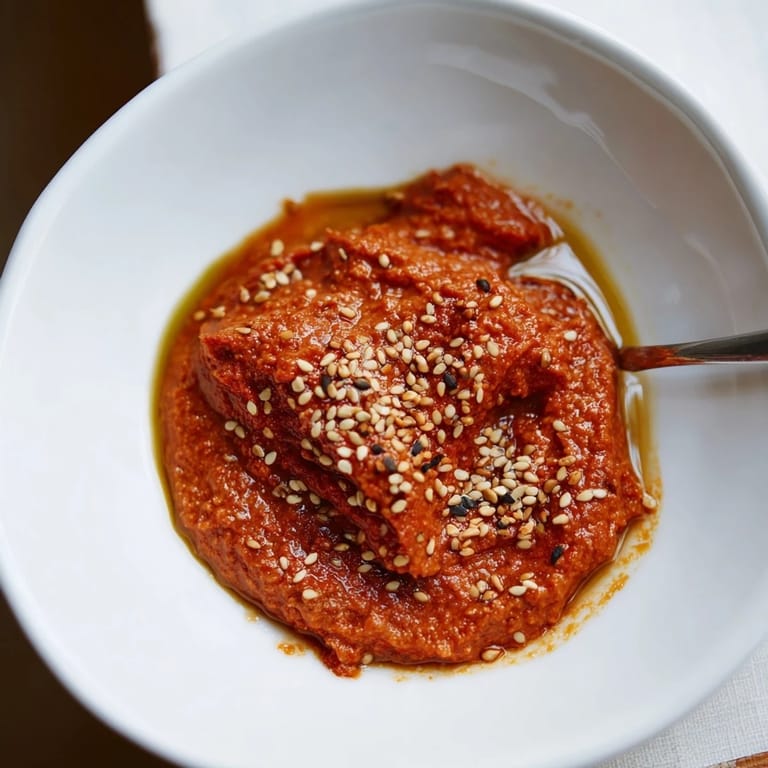
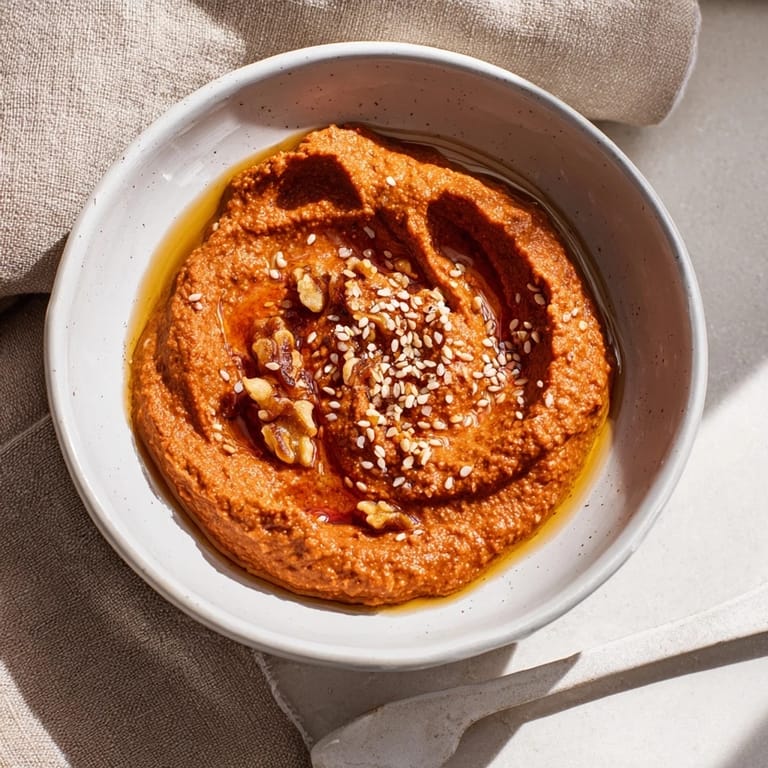
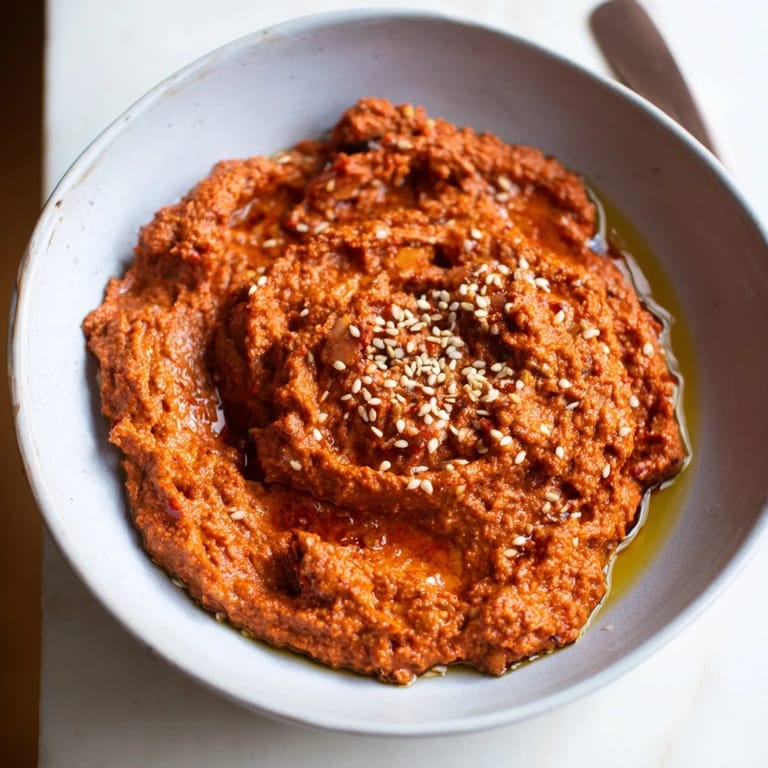
- Transfer to a shallow bowl, drizzle generously with olive oil, and scatter toasted sesame seeds over the top. The oil and seeds aren't decorative—they're part of how you eat it.
 Save
Save Years later, I served this to my partner when they were having a rough day, and they ate it standing at the kitchen counter, straight from the bowl with pieces of pita, and didn't say a word until the bowl was nearly empty. Then they said, 'I didn't know I needed this,' and suddenly food was friendship again.
Where Smoke and Sweetness Collide
The beauty of muhammara is that it lives in the space between flavors—the peppers are naturally sweet, the walnuts bring earthiness, the pomegranate molasses cuts through with sharp fruitiness, and the smoke from roasting ties it all together. If you've ever wondered why certain dips feel one-dimensional while others make you want to keep eating, it's usually because one flavor is dominating. Here, they're equals in a conversation that never gets boring. I've learned to respect that balance and not fiddle with it endlessly, because sometimes the recipe works because someone figured it out centuries ago.
Serving and Occasions
Muhammara doesn't ask for much beyond good pita and honest company. I serve it as part of a mezze platter with hummus and baba ghanoush, where each dip has its own character and together they're greater than the sum of their parts. It's also perfect as a simple appetizer when you want people to eat slowly and talk more. The dip practically forces you to pause and taste, which in a world of rushed meals feels like a small rebellion.
Making It Your Own
Once you understand the core of this recipe, you can begin to nudge it gently. Some cooks grill their peppers over an open flame for extra smoke, others add a pinch of cinnamon for warmth, and I once tried pomegranate seeds folded in at the end for texture. The foundation is solid enough to handle experiments, and that's when cooking becomes truly personal. I learned this not from reading about it but from making it wrong once and accidentally creating something I liked even better, which taught me that recipes are invitations, not commandments.
- For deeper smoke, roast the peppers over an open flame or grill instead of in the oven.
- Store it in an airtight container in the fridge for up to 5 days, and always drizzle with fresh olive oil before serving.
- If you can't find pomegranate molasses, you can make a substitute by reducing pomegranate juice, though the flavor won't be quite as sharp.
 Save
Save Muhammara is proof that the simplest ingredients, treated with respect and attention, can become something worth seeking out. I make it now not because I'm chasing a memory, but because it's become its own memory every time.
Common Questions
- → What is the best way to roast the red peppers?
Roast red peppers at 220°C (425°F) until skins are charred and blistered, about 20-25 minutes. Steaming afterward helps loosen skins for easy peeling.
- → Can I adjust the spice level of this dish?
Yes, control heat by varying the amount of Aleppo pepper or red chili flakes according to taste preferences.
- → How should the walnuts be prepared before blending?
Lightly toast walnuts to enhance their flavor and crunch before combining them with other ingredients.
- → What alternatives exist for breadcrumbs for gluten-free needs?
Use gluten-free breadcrumbs or substitute with ground nuts or seeds to maintain texture without gluten.
- → How long can this dip be stored safely?
Refrigerate in an airtight container and consume within 5 days for best freshness and safety.